Connecting Qiniu Cloud Object Storage (Kodo)
This guide walks you through connecting a Qiniu Cloud Object Storage (Kodo) storage destination to Pluton.
Prerequisites
Before connecting Qiniu Kodo, you need:
- A Qiniu Cloud account — Sign up here
- An Access Key (AK) and Secret Key (SK) from the Qiniu developer portal
Getting Your Qiniu Kodo Credentials
Step 1: Obtain Access Keys
- Log into the Qiniu Developer Portal
- Navigate to Key Management in your account settings
- Your Access Key (AK) and Secret Key (SK) are displayed on this page
- Copy both values — you will need them when configuring Pluton
Step 2: Prepare Your Bucket
- Navigate to Object Storage (Kodo) in the Qiniu console
- Note the bucket name you want to use, or click Create Bucket to make a new one
- Note the Region and Storage Class for your bucket
Connecting to Pluton
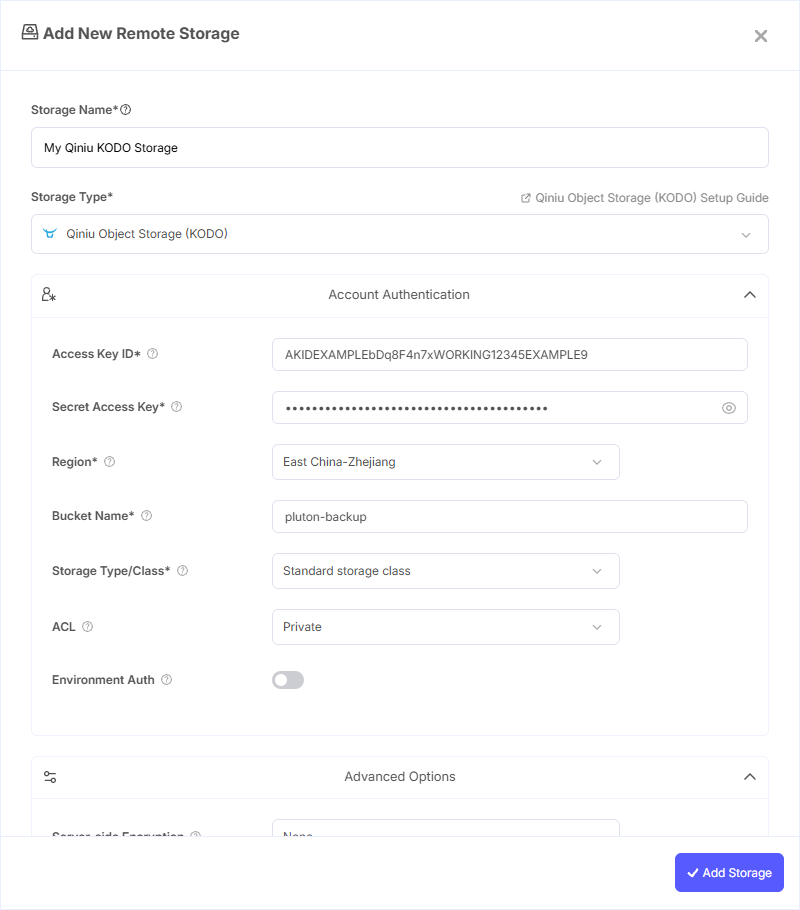
Step 1: Add Storage
- In Pluton, navigate to Storages
- Click Add Storage button
- Select Qiniu Cloud Object Storage (Kodo) from the provider list
Step 2: Configure Connection
Fill in the required fields:
- Storage Name: A friendly name (e.g., "Qiniu Kodo Backups")
- Access Key ID: Your Qiniu Access Key (AK)
- Secret Access Key: Your Qiniu Secret Key (SK)
- Region: Select the region matching your bucket location. Available regions include East China-Zhejiang, East China-Zhejiang 2, North China-Hebei, South China-Guangdong, Northwest-Shaanxi, North America-Los Angeles, Asia Pacific-Singapore, Asia Pacific-Hanoi, and Asia Pacific-Ho Chi Minh. You can also enter a custom region if needed
- Storage Type/Class: Select the storage class for new objects. Options include Standard, Infrequent Access, Archive, Archive (Direct Read), Deep Archive, and Intelligent Tiering
- Bucket Name: Your Qiniu Bucket Name
Step 3: Advanced Options (Optional)
Additional settings available:
- ACL: Access control permissions applied when creating buckets and storing objects. Options are Private and Public Read
- Server-side Encryption: Encrypt objects at rest using AES256 or AWS KMS
- Bucket ACL: Canned ACL applied specifically when creating buckets
- Requester Pays: Enable requester pays option when interacting with the bucket
Step 4: Complete the Storage Setup
- Click the Add Storage button which automatically verifies credentials and adds the storage.
- Your Qiniu Kodo storage is now ready for backup plans
Common Issues
Authentication Failure: Verify that your Access Key (AK) and Secret Key (SK) are correct. You can view and regenerate keys in the Qiniu Developer Portal under Key Management.
Region Mismatch: The selected region must match the region where your bucket was created. Each region has a distinct S3-compatible endpoint.
Storage Class Error: Ensure the selected storage class is available for your bucket's region. Not all storage classes may be available in every region.
Best Practices
- Use the Standard storage class for frequently accessed backup data
- Use Infrequent Access or Archive classes for long-term retention backups to reduce costs
- Select a region close to your Pluton server for faster backup transfers
- Monitor storage usage through the Qiniu console to manage costs effectively