Connecting Tencent Cloud Object Storage (COS)
This guide walks you through connecting a Tencent Cloud Object Storage (COS) storage destination to Pluton.
Prerequisites
Before connecting Tencent COS, you need:
- A Tencent Cloud account — Sign up here
- A SecretId (Access Key ID) and SecretKey (Secret Access Key) from the Tencent Cloud API key management
Getting Your Tencent COS Credentials
Step 1: Create API Keys
- Log into the Tencent Cloud Console
- Navigate to Access Management > API Keys > Manage API Key
- Click Create Key
- Copy the SecretId and SecretKey — the SecretKey is shown only once
- For better security, consider creating a sub-account with CAM (Cloud Access Management) and generating keys for that account
Step 2: Prepare Your Bucket and Endpoint
- Navigate to Cloud Object Storage in the Tencent Cloud console
- Note the bucket you want to use, or click Create Bucket to make a new one
- Note the bucket's Endpoint — it follows the format
examplebucket-1250000000.cos.ap-guangzhou.myqcloud.comand includes the bucket name, APPID, and region
Connecting to Pluton
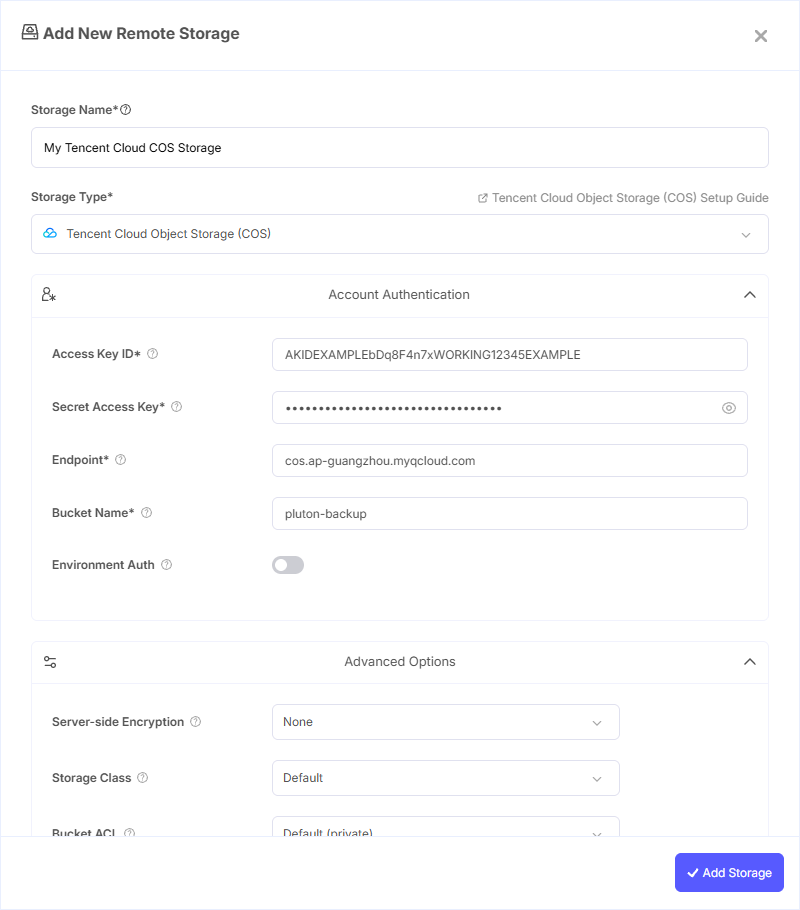
Step 1: Add Storage
- In Pluton, navigate to Storages
- Click Add Storage button
- Select Tencent Cloud Object Storage (COS) from the provider list
Step 2: Configure Connection
Fill in the required fields:
- Storage Name: A friendly name (e.g., "Tencent COS Backups")
- Access Key ID: Your Tencent Cloud SecretId
- Secret Access Key: Your Tencent Cloud SecretKey (password)
- Endpoint: Your Tencent COS endpoint URL (e.g.,
examplebucket-1250000000.cos.ap-guangzhou.myqcloud.com). This includes the bucket name, APPID, and region - Bucket Name: Your Tencent COS Bucket Name
Step 3: Advanced Options (Optional)
Additional settings available:
- Server-side Encryption: Encrypt objects at rest using AES256 or AWS KMS
- Storage Class: The storage class for new objects (Standard, Standard IA, Glacier, etc.)
- Bucket ACL: Canned ACL applied when creating buckets (Private, Public Read, etc.)
- Requester Pays: Enable requester pays option when interacting with the bucket
Step 4: Complete the Storage Setup
- Click the Add Storage button which automatically verifies credentials and adds the storage.
- Your Tencent COS storage is now ready for backup plans
Common Issues
Authentication Failure: Verify that you are using the correct SecretId and SecretKey. If using a sub-account, ensure it has COS read/write permissions via CAM policies.
Invalid Endpoint: The endpoint must include the full bucket address in the format bucketname-APPID.cos.region.myqcloud.com. You can find this on the bucket's Overview page in the Tencent Cloud console.
Permission Denied: Check that your API key or sub-account has the appropriate COS permissions (e.g., cos:PutObject, cos:GetObject, cos:DeleteObject).
Best Practices
- Create a dedicated sub-account via CAM with least-privilege COS permissions
- Use the endpoint region closest to your Pluton server for faster transfers
- Enable versioning on your COS bucket for additional data protection
- Review Tencent Cloud's storage class tiers to optimize costs for backup data