Connecting Linode Object Storage
This guide walks you through connecting a Linode Object Storage destination to Pluton.
Prerequisites
Before connecting Linode Object Storage, you need:
- A Linode (Akamai) account - Sign up here
- Object Storage enabled on your account
- An access key pair (Access Key and Secret Key)
Getting Your Linode Credentials
Step 1: Enable Object Storage
- Log into the Linode Cloud Manager
- Click Object Storage in the left sidebar
- If prompted, enable the Object Storage service
Step 2: Create Access Keys
- In the Object Storage section, go to the Access Keys tab
- Click Create Access Key
- Enter a label (e.g., "Pluton Backups")
- Choose Unlimited Access or restrict to specific buckets
- Click Create Access Key
- Important: Copy both the Access Key and Secret Key immediately — the Secret Key is shown only once
Step 3: Create a Bucket
- Go to the Buckets tab in Object Storage
- Click Create Bucket
- Enter a bucket label and select a region (e.g., Newark, Frankfurt, Singapore)
- Click Create Bucket
Connecting to Pluton
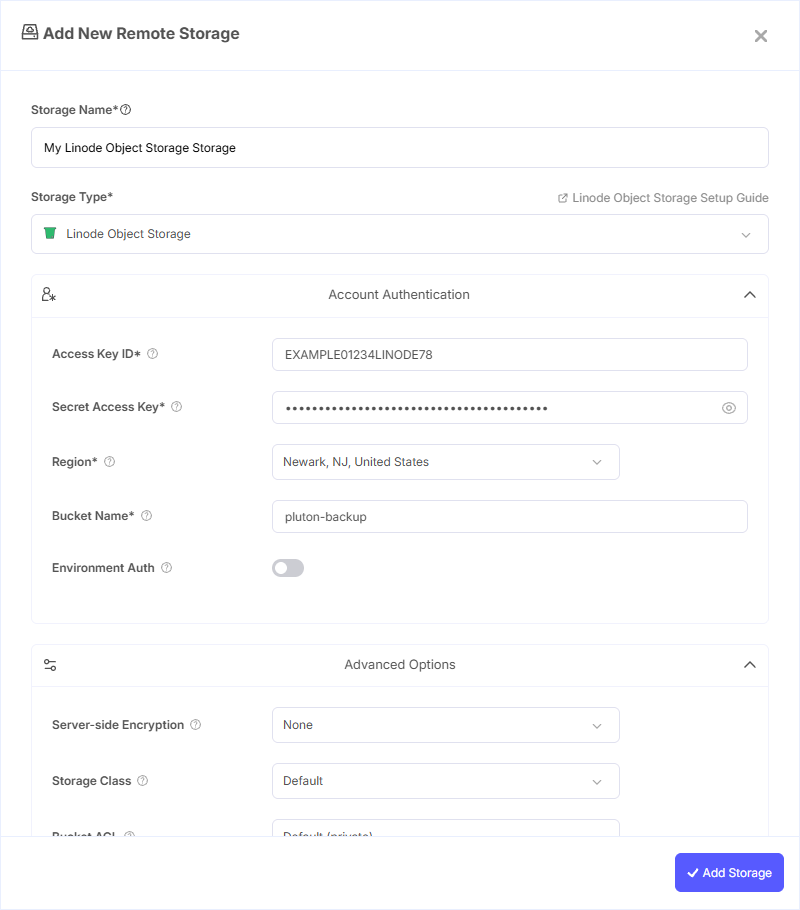
Step 1: Add Storage
- In Pluton, navigate to Storages
- Click Add Storage button
- Select Linode Object Storage from the provider list
Step 2: Configure Connection
Fill in the required fields:
- Storage Name: A friendly name (e.g., "Linode Backups")
- Access Key ID: Your Linode Object Storage Access Key
- Secret Access Key: Your Linode Object Storage Secret Key (password)
- Region: Select the region where your bucket is located (e.g., Newark, Frankfurt, Singapore, Sydney). You can also enter a custom endpoint
- Bucket Name: Your Linode Bucket Name
Step 3: Advanced Options (Optional)
Additional settings available:
- Server-side Encryption: Choose AES256 or KMS encryption for data at rest
- Storage Class: Select the storage tier for your objects
- Chunk Size: Adjust the chunk size for multipart uploads (default: 5 MiB)
- Upload Cutoff: Set the threshold for switching to chunked uploads (default: 200 MiB)
- Force Path Style: Enable path-style access instead of virtual hosted-style
Step 4: Complete the Storage Setup
- Click the Add Storage button which automatically verifies credentials and adds the storage.
- Your Linode Object Storage is now ready for backup plans
Common Issues
Region Mismatch: Ensure the selected region matches the datacenter where your bucket was created. Each region has a distinct endpoint (e.g., us-east-1.linodeobjects.com).
Access Denied: Verify your access key has permissions for the target bucket. If using limited access keys, ensure the bucket is included in the key's scope.
Bucket Not Found: Bucket labels are unique per region. Ensure you're using the correct label and that it exists in the selected region.
Best Practices
- Use limited access keys restricted to specific buckets for better security
- Choose a region close to your Pluton server for faster transfer speeds
- Linode Object Storage is available in many global regions — pick the closest one
- Monitor storage usage through the Linode Cloud Manager to manage costs