Connecting Leviia Object Storage
This guide walks you through connecting a Leviia Object Storage destination to Pluton.
Prerequisites
Before connecting Leviia Object Storage, you need:
- A Leviia account - Sign up here
- S3 API credentials (Access Key ID and Secret Access Key) from your Leviia dashboard
Getting Your Leviia Credentials
Step 1: Generate S3 API Keys
- Log into your Leviia Dashboard
- Navigate to the Object Storage section
- Go to API Keys or S3 Credentials
- Click Create Key to generate a new key pair
- Copy the Access Key ID and Secret Access Key
- Important: Save both credentials immediately - the Secret Access Key may only be shown once
Step 2: Note Your Endpoint and Bucket
- In the Leviia dashboard, find your assigned S3 endpoint (e.g.,
s3.eu-west.leviia.com) - Create a bucket or note the name of an existing bucket you want to use for backups
Connecting to Pluton
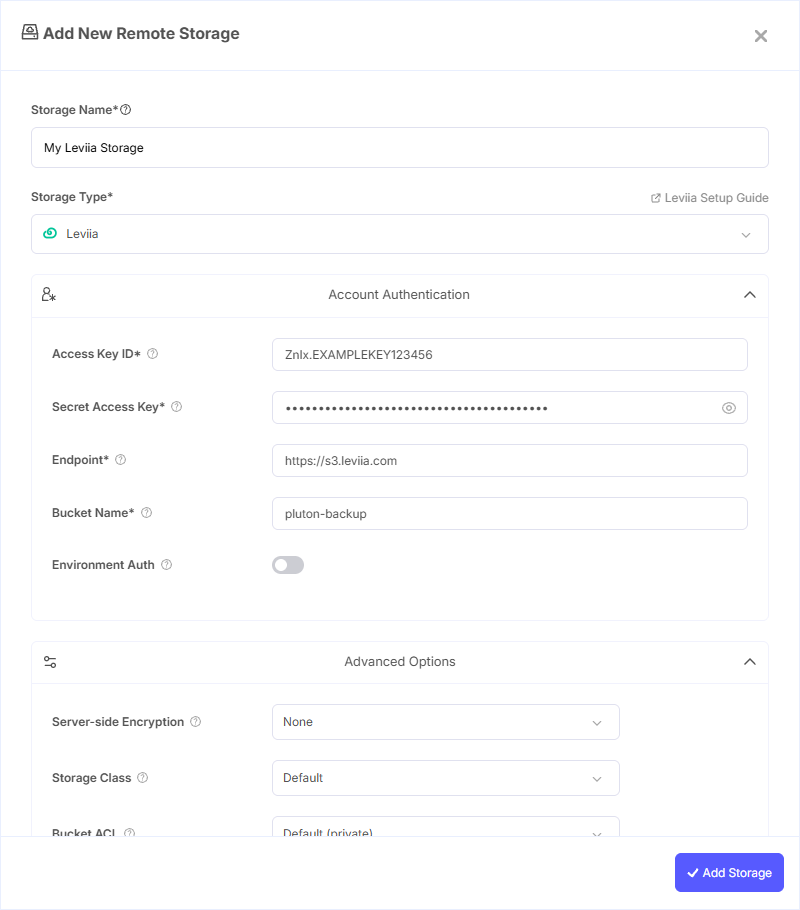
Step 1: Add Storage
- In Pluton, navigate to Storages
- Click Add Storage button
- Select Leviia Object Storage from the provider list
Step 2: Configure Connection
Fill in the required fields:
- Storage Name: A friendly name (e.g., "Leviia Backups")
- Access Key ID: Paste your Leviia S3 Access Key ID
- Secret Access Key: Paste your Leviia S3 Secret Access Key
- Endpoint: Your Leviia S3 endpoint (e.g.,
s3.eu-west.leviia.com) - Bucket Name: Your Leviia Bucket Name
Step 3: Advanced Options (Optional)
Additional settings available:
- Server-side Encryption: Choose AES256 or KMS encryption for data at rest
- Storage Class: Select the storage class for new objects
- Bucket ACL: Set access control for bucket operations
- Upload Cutoff: Threshold for switching to chunked uploads (default: 200 MiB)
- Chunk Size: Size of chunks for multipart uploads (default: 5 MiB)
- Force Path Style: Enabled by default; use path-style access for S3 requests
Step 4: Complete the Storage Setup
- Click the Add Storage button which automatically verifies credentials and adds the storage.
- Your Leviia Object Storage is now ready for backup plans
Common Issues
Authentication Failure: Verify your Access Key ID and Secret Access Key are correct. Regenerate credentials in the Leviia dashboard if needed.
Endpoint Error: Ensure the endpoint matches the one provided in your Leviia dashboard (e.g., s3.eu-west.leviia.com). Do not include the https:// prefix.
Bucket Not Found: Confirm the bucket name exists in your Leviia account and that your API key has access to it.
Best Practices
- Create dedicated API keys for Pluton with appropriate permissions
- Use the endpoint region closest to your Pluton server for best performance
- Enable server-side encryption for sensitive backup data
- Monitor storage usage through the Leviia dashboard regularly