Connecting ownCloud
This guide walks you through connecting an ownCloud instance to Pluton for backing up your files. ownCloud is an open-source file sync and share platform with full WebDAV support. Pluton connects to ownCloud via the WebDAV protocol, giving you incremental backups of your ownCloud files.
Prerequisites
Before connecting ownCloud, you need:
- An ownCloud instance (self-hosted or managed) — either ownCloud 10 or ownCloud Infinite Scale
- Your ownCloud username and password (or an app password if 2FA is enabled)
Getting Your ownCloud WebDAV URL
ownCloud 10
Your WebDAV URL follows this format:
https://your-owncloud-server.com/remote.php/webdav/
To find it in ownCloud:
- Log into your ownCloud instance
- Click on Files in the top navigation
- Click the Settings cog icon in the bottom-left corner
- Copy the WebDAV URL shown there
ownCloud Infinite Scale
For ownCloud Infinite Scale, your WebDAV URL follows this format:
https://your-owncloud-server.com/dav/files/<username>/
Generating an App Password (If Using 2FA)
If you have two-factor authentication enabled on your ownCloud account:
- Log into ownCloud and go to Settings → Security
- Scroll down to App passwords (or Devices & sessions)
- Enter a name for the app (e.g., "Pluton Backup") and click Create new app password
- Copy the generated app password — you'll use it as the Password in Pluton
Even without 2FA, using an app password is recommended. It can be revoked independently without changing your main account password.
Connecting to Pluton
Step 1: Add Storage
- In Pluton, navigate to Storages
- Click Add Storage button
- Select WebDAV from the provider list
Step 2: Configure Connection
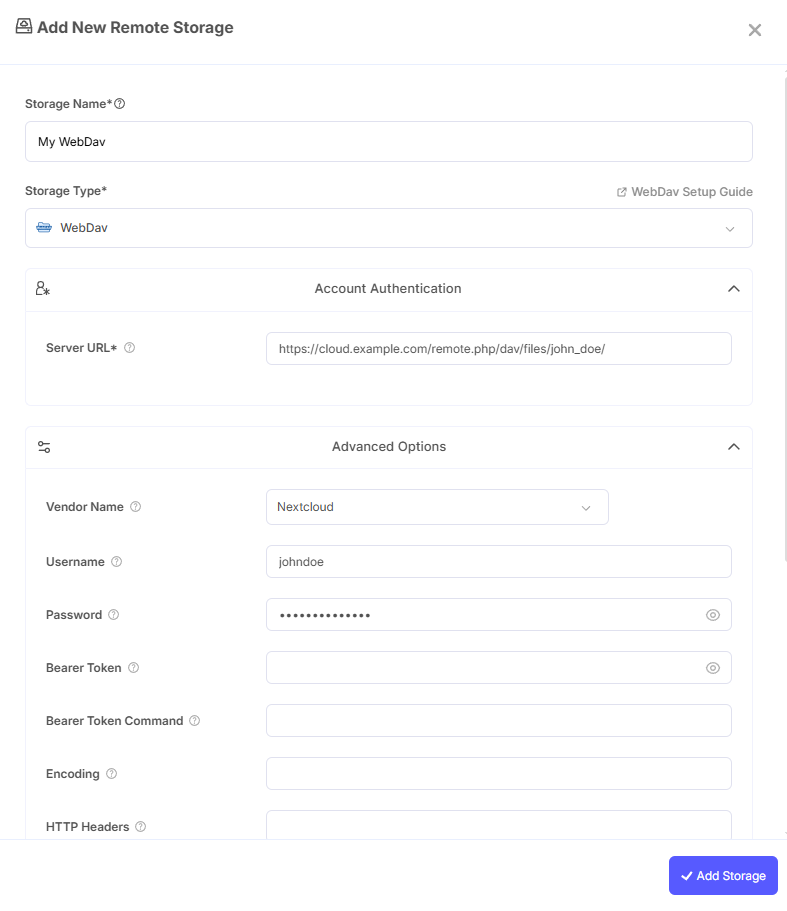
Fill in the required fields:
- Storage Name: A friendly name (e.g., "ownCloud Backups")
- Server URL: Your ownCloud WebDAV URL (e.g.,
https://your-owncloud-server.com/remote.php/webdav/) - Vendor Name: Set to
owncloud(orinfinitescalefor ownCloud Infinite Scale) - Username: Your ownCloud username
- Password: Your ownCloud password (or app password if 2FA is enabled)
Step 3: Advanced Options (Optional)
Additional settings available:
- Exclude OwnCloud Shares: Exclude shared files from listings (default:
false). Enable this if you only want to back up your own files and not files shared with you. - Exclude OwnCloud Mounts: Exclude mounted external storages from listings (default:
false). Enable this to skip external storage mounts configured in ownCloud. - Bearer Token: Use a bearer token for authentication instead of username/password
- Encoding: Override the default backend encoding
- HTTP Headers: Set custom HTTP headers for all transactions
- Pacer Min Sleep: Minimum time to sleep between API calls (default:
10ms)
Step 4: Test and Save
- Click Test Connection to verify your credentials and server URL
- If successful, click Save
- Your ownCloud storage is now ready for backup plans
Common Issues
Connection Refused or Timeout: Verify your Server URL is correct and includes the full path (e.g., /remote.php/webdav/ for ownCloud 10 or /dav/files/<username>/ for Infinite Scale). Ensure the server is reachable from the machine running Pluton.
Authentication Failure: Double-check your username and password. If your ownCloud account uses 2FA, you must use an app password — your regular password will not work.
SSL/TLS Errors: Ensure your ownCloud instance has a valid SSL certificate. Self-signed certificates may cause connection failures.
Vendor Mismatch: Use owncloud for ownCloud 10 and infinitescale for ownCloud Infinite Scale. Setting the wrong vendor can cause unexpected behavior.
Best Practices
- Always use HTTPS to encrypt data in transit
- Use app passwords instead of your main account password
- Set the correct Vendor Name (
owncloudorinfinitescale) to enable service-specific optimizations - Use the Exclude OwnCloud Shares and Exclude OwnCloud Mounts options to limit backups to only your own files
- Regularly verify your app password hasn't been revoked
- Monitor your ownCloud storage quota to ensure there is enough space for backups