Installing Pluton on Desktop
Pluton can be easily installed with just a few clicks on desktop OSs like Windows 10, macOS, Ubuntu Desktop, Debian Desktop, Fedora, etc.
Pluton stores sensitive setup data in protected local files with strict permissions instead of the OS credential manager.
Download the necessary executables from this table for your system to get started:
| OS | Architecture | Download Link |
|---|---|---|
| Windows 10/11 | x64 | Download (exe) |
| macOS | Apple Silicon / Intel | Via Homebrew |
| Linux | x64 | Download (AppImage) |
| Linux | Arm64 | Download (AppImage) |
Installing
Installing on Windows
- First, download the exe file from the table above.
- Run the installer.
- During installation, set the port number where the Pluton server should run.
- After installation, open
http://localhost:5173in your browser. If you set any port other than the default5173, use that instead. - When you first load Pluton on desktop, you will see a setup screen where you need to set your encryption key and admin username and password. These sensitive values are stored in protected local files with strict permissions.
- After setup, you will be redirected to the login page. Log in with your admin username and password.
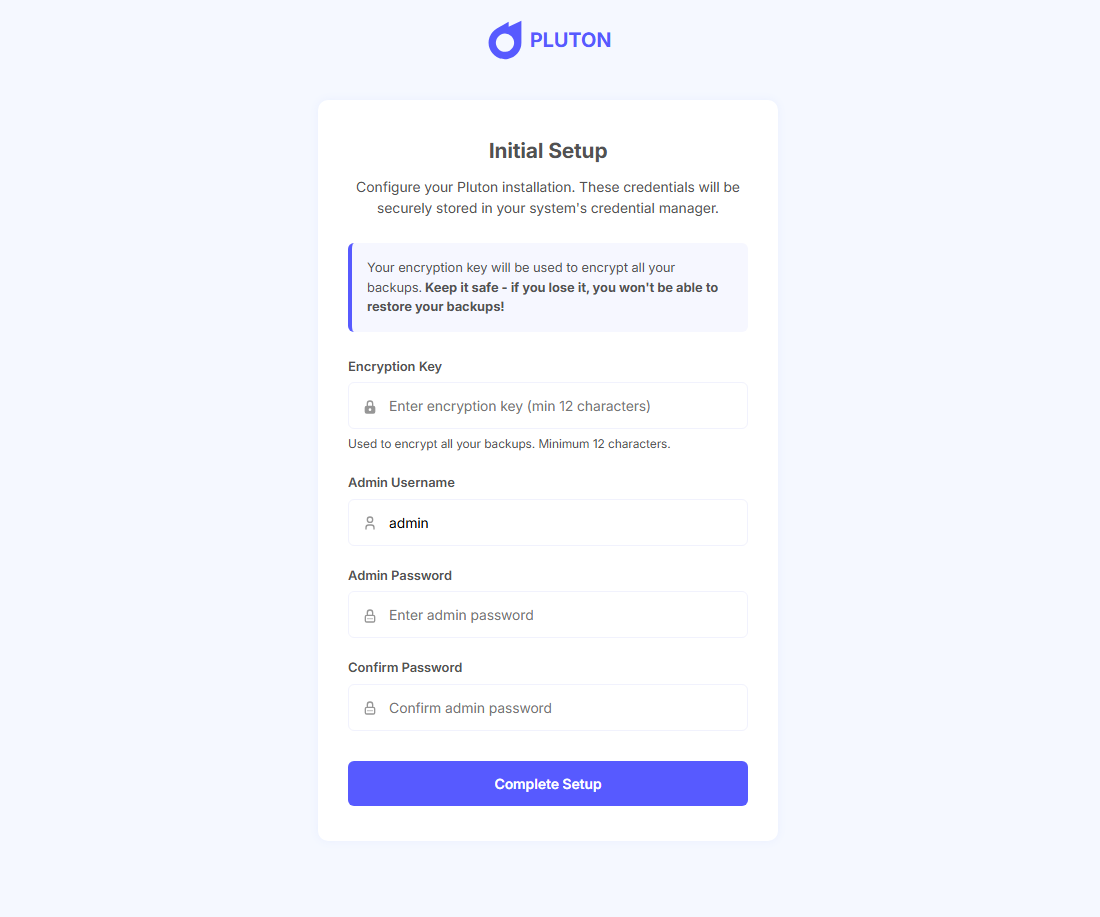
Note: Never lose your encryption key. The encryption key is used to encrypt all your backups. If you lose it, you may not be able to restore or access your backup data.
Files written on Windows:
| File | Description |
|---|---|
C:\ProgramData\Pluton\ | Primary data directory containing Pluton's database, logs, backups, and runtime state. |
C:\ProgramData\Pluton\pluton.enc.env | Stores the encryption key with restricted NTFS ACLs. |
C:\ProgramData\Pluton\config\config.json | Stores non-sensitive application settings such as the server port and backup concurrency. |
Installing on macOS
Pluton is installed on macOS via Homebrew. It supports both Apple Silicon (arm64) and Intel (x86_64) Macs running macOS Monterey (12) or later.
- Add the Pluton Homebrew tap:
brew tap plutonhq/pluton
- Install Pluton:
brew install plutonhq/pluton/pluton
- After installation, open
http://localhost:5173in your browser. - On first launch, complete the setup wizard:
- Set your encryption key (minimum 12 characters)
- Create your admin username and password
- After setup, log in with your admin credentials.
Note: Never lose your encryption key. The encryption key is used to encrypt all your backups. If you lose it, you may not be able to restore or access your backup data.
Files written on macOS:
| File | Description |
|---|---|
/var/lib/pluton/ | Primary data directory containing Pluton's database, logs, backups, and runtime state. |
/var/lib/pluton/pluton.enc.env | Stores the encryption key with restrictive file permissions. |
/var/lib/pluton/config/config.json | Stores non-sensitive application settings such as the server port and backup concurrency. |
To back up files in protected directories (Desktop, Documents, etc.), grant Full Disk Access to the Pluton binary:
System Settings → Privacy & Security → Full Disk Access → Click + and add /opt/pluton/pluton
You can press Cmd+Shift+G in the file picker dialog to type the path directly.
Installing on Linux Desktop
- First, download the AppImage file from the table above for your architecture type.
- Open a terminal where the AppImage file is located and then run this command:
sudo ./Pluton-0.0.1-x86_64.AppImage --install - During installation, set the port number where the Pluton server should run.
- After installation, open
http://localhost:5173in your browser. If you set any port other than the default5173, use that instead. - When you first load Pluton on desktop, you will see a setup screen where you need to set your encryption key and admin username and password (screenshot above). These sensitive values are stored in protected local files with strict permissions.
- After setup, you will be redirected to the login page. Log in with your admin username and password.
The AppImage installer runs with sudo so it can install the service and helper binary. After installation, the Pluton service runs as the dedicated non-root pluton system user.
Note: Never lose your encryption key. The encryption key is used to encrypt all your backups. If you lose it, you may not be able to restore or access your backup data.
Linux desktop installs use a least-privilege model:
- The systemd service runs as the
plutonuser and group, not as root. - Runtime data under
/var/lib/pluton/and sensitive environment files under/etc/pluton/are owned byplutonwith restrictive permissions. /usr/bin/pluton-helperis installed for narrow elevated operations such as privileged restores and root-approved hook scripts.
If you store backups in a local mounted path, external drive, or another directory outside /var/lib/pluton, grant the pluton user write access to that destination:
sudo apt update && sudo apt install acl -y
sudo setfacl -R -m u:pluton:rwx,d:u:pluton:rwx /path/to/pluton-backups
Normal plan scripts run as the pluton user. If a script needs root privileges, enable root execution in the plan settings and allow only that script through sudoers:
sudo tee /etc/sudoers.d/pluton-helper-scripts >/dev/null <<'EOF'
pluton ALL=(root) NOPASSWD: /usr/bin/pluton-helper run-script /usr/local/libexec/pluton-hooks/pre-backup-root.sh
EOF
sudo chmod 440 /etc/sudoers.d/pluton-helper-scripts
sudo visudo -c -f /etc/sudoers.d/pluton-helper-scripts
Files written on Linux Desktop:
| File | Description |
|---|---|
/usr/bin/pluton-helper | Least-privilege helper for elevated Linux tasks |
/var/lib/pluton/ | Primary data directory containing Pluton's database, logs, backups, and runtime state. |
/etc/pluton/pluton.env | Stores the admin username and password with restrictive file permissions. |
/etc/pluton/pluton.enc.env | Stores the encryption key with restrictive file permissions. |
/var/lib/pluton/config/config.json | Stores non-sensitive application settings such as the server port and backup concurrency. |
Updating
Updating Pluton on Windows
- Download the latest version.
- Run the installer.
Updating Pluton on macOS
brew update
brew upgrade pluton
Your configuration and data are preserved during the update.
Updating Pluton on Linux Desktop
- Download the latest version.
- Run this command in the terminal:
sudo ./Pluton-x86_64.AppImage --install
Uninstalling
Uninstalling Pluton on Windows
- Navigate to
C:/Program Files/Pluton - Run
uninstall.exe
Uninstalling Pluton on macOS
Stops the service and removes the LaunchDaemon, but preserves your data:
brew uninstall pluton
To fully uninstall and remove all data:
brew uninstall --zap pluton
Uninstalling Pluton on Linux Desktop
From the terminal, run this command:
sudo /opt/pluton/uninstall.sh
Troubleshooting
I lost my password, how do I reset it?
Windows
Follow these steps to reset your password on Windows 10/11
-
Open Powershell or CMD.
-
First navigate to the Pluton Installation folder:
cd "C:\Program Files\Pluton"
- Then run the reset-password command:
./pluton.exe --reset-password
- You will be prompted to set both the admin username and password.
- After setting the new password, use that to login to Pluton.
MacOS
Follow these steps to reset your password on Windows 10/11
-
Open Terminal.
-
Run this command to start the password reset process:
sudo /opt/pluton/pluton --reset-password
- You will be prompted to set both the admin username and password.
- After setting the new password, use that to login to Pluton.
Linux Desktop
Follow these steps to reset your password on Windows 10/11
-
Open Terminal.
-
Run this command to start the password reset process:
/opt/pluton/pluton --reset-password
- You will be prompted to set both the admin username and password.
- After setting the new password, use that to login to Pluton.